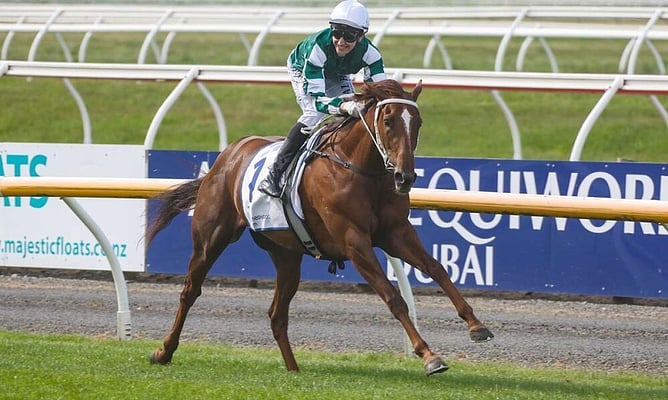
Five, ten or 20 years from now a glance at the result of the 2026 NZB Kiwi (Listed, 1500m), will read that the favourite, Well Written (Written Tycoon), duly won from Belle Cheval (Savabeel) by a very small margin.
That is the cold fact but on site the race was electric, especially over the final few metres when Belle Cheval rushed hard late. Did Well Written hold on?
Seconds later the crowd gasped when the head-on camera showed Well Written veering toward the outside rail. Did she contact Belle Cheval? Did Belle Cheval’s jockey have to stop riding?
On top of Alabama Lass (Alabama Express) knocking over the running rail when leading the King’s Plate (Gr 3, 1200m) then Legarto (Proisir) inching past Waitak (Proisir) to claim a nostalgic last New Zealand win, the Kiwi provided its own thrills and the public were properly entertained by top class racing. Unfortunately, Champions Day only occurs once a year.
Anything can happen
Stephen Marsh, trainer of Well Written, can now appreciate what Peter Moody and Chris Waller experienced when managing the careers of Black Caviar (Bel Esprit) and Winx (Street Cry). The former was unbeaten in 25 starts whereas the latter strung together 33 successive wins. Well Written’s record stands at six but pressure is the same. It is not until race day and scoring the next win that the trainer is satisfied that he or she is doing the right thing.
As suggested in Kiwi Chronicles (Feb 24th): “On paper, Well Written is clearly the one to beat plus she has Belle Cheval’s scalp from the (New Zealand 1,000) Guineas but the race is not run on paper. At this point, Belle Cheval looks the biggest threat and her last two runs have shown she is in for the fight. Her connections will have more than a smidge of confidence leading into the big race with the possible added advantage of more recent race fitness.”
Well Written’s previous start was January 24, in the Karaka Million 3YO Classic (RL, 1600m) compared with Belle Cheval, who won the Uncle Remus Stakes (Gr 3, 1400m) at Ellerslie on February 21. Belle Cheval had also won on January 24, the Group 3 Almanzor Trophy (1200m). That extra run ensured she was fit for her challenge and she very nearly upset Well Written who may have lacked the same sharpness.
Matt Cartwright aboard Well Written had to make his move earlier than planned and raced clear from the 300m. From second last, Belle Cheval kept up a strong run in the straight, looking like she might overhaul the winner who kicked late to barely hold on by a short half-head. A stride past the post Belle Cheval was in front in a splendid effort.
There was no contact even though Well Written veered towards the outside rail at the 50m. Noted in the Stewards’ report was that Belle Cheval also changed ground by shifting inwards from the 150m. The Stewards dismissed the protest by Belle Cheval’s connections.
The $80,000 outlay for Well Written at the 2024 NZB Online National Yearling Sale was $80,000 well spent as the filly has banked more than $2.6 million. Significantly, she remains unbeaten in six starts, five of which are stakes including a precious Group 1 and is looking like New Zealand’s Horse of the Year. From all accounts, her next start will be in Australia but not this autumn. An Australian Group 1 is the target.
Flemington revisit
The Australian Cup (Gr 1, 2000m) is a distinct possibility for Legarto who rounded out her New Zealand career with a tenacious first Ellerslie Group 1 victory in Saturday’s Bonecrusher New Zealand Stakes (2000m), making it back-to-back Group 1s, having scored a second Herbie Dyke Stakes (2000m) at Te Rapa a month ago.
In Saturday’s New Zealand swansong she had three behind her at the 1000m and began her run from the 600m. With 300m remaining she had four to beat. At the 200m it was down to two and at the 100m just one but over the final 50m she gradually got the upper hand over Waitak and was able to hold the advantage to the line.
Legarto is no stranger to Flemington. Her victory in the 2023 Australian Guineas (Gr 1, 1600m) places her in rare company and when she shows up at the Magic Millions National Broodmare Sale this May she is certain to attract much attention. An Australian Group 1 is treasured. That she has four further Group 1s is a pure bonus. Also, four of her five placings are at the elite level. She is all quality.
Lightly raced, six-year-old Legarto has faced the starter just 24 times and has won half of them, earning more than $3 million. On the downside is that no New Zealand stud or ownership group will be able to afford her. She will be lost to the New Zealand Stud Book.
Stablemate skittles plans
Yulong’s tactical New Zealand Derby (Gr 1, 2400m) move, withdrawing their recent purchase Ohope Wins (Ocean Park) in order to potentially secure a Group 1 by another recent purchase, Autumn Glory (Ocean Park), almost paid off. Their tactic didn’t allow for the Derby-winning mastery of Roger James. Winner Road To Paris (Circus Maximus) is trained by the same Roger James in partnership with Robert Wellwood.
Road To Paris arrived at Ellerslie as a one-race winner from six starts although he was twice first past the post. At Otaki last November, for the Wellington Stakes (Gr 3, 1600m), he had that race won but shied at the 50m, dropping his rider.
In the interim he placed twice including a last-start second in the Avondale Guineas (Gr 2, 2100m), finishing strongly yet racing greenly, a trait he repeated on Saturday resulting in an enquiry. On this occasion he shifted inwards and hampered both Autumn Glory and third placed Geneva (Time Test). Rider George Rooke was suspended until March 27 and fined $10,000 so the interference was clearly quite severe yet the stewards allowed the placings to stand.
Road To Paris sat second last until the 800m but the field compacted near the last corner and he was able to track Autumn Glory to the 300m, sitting fifth. There were four across the track at the 200m but at the 100m just two, Road To Paris and Autumn Glory had sorted themselves out with the former outstaying the filly. Geneva was a shade unlucky and lunged late for a solid third.
Not sold at any sale, he is the fifth winner of five to race from four-race winner Spirit Of Heaven (Savabeel) who ranks as a three-quarter sister to Lights Of Heaven (Zabeel), winner of the Australasian Oaks (Gr 1, 2000m). Lights Of Heaven was all class and landed five other Group wins and was three times Group 1 placed.
This is the family of four-time Group 1 winner Alamosa (O’Reilly) and traces to Starquita (Star Kingdom), the dam of another New Zealand Derby winner, Mansingh (Wilkes), although that was more than 50 years ago.
The win boosts the fortunes of Windsor Park Stud’s Circus Maximus (Galileo), now the sire of a Group 1 winner from his first crop and three in total.
Tweaks?
Edition two of the NZB Kiwi was different. Not better, not worse, just different.
Compared with edition one, Auckland Thoroughbred Racing, in conjunction with New Zealand Bloodstock, NZTR and Entain, took what clearly worked well in 2025 and applied the same formula. The question is: Did it work this time around?
Official attendance figures aside, the birdcage area in front of the Members’ stand was nowhere near as busy as it was last year, especially for the $4 million Kiwi. In 2025, that area was packed and patrons had to stand shoulder to shoulder. This year, not so much. There was plenty of space. The loud speaker system was loud. Holding a one-to-one conversation in the birdcage area was difficult. The volume was one thing but the drums and bass were another. The effect was bone shaking.
The big race itself was also different. The most notable difference was that this year one runner dominated the betting and had done so for many, many weeks. The 2025 field was more even.
Well Written virtually scared the opposition away. The remaining slot holders were playing for second place which took away some of the interest. Meanwhile, three eligible Australians fronted in 2025 but just one found its way to Ellerslie this time, also taking away some interest.
One thing remained the same and that is the prize-money payout to the winner which remained at $1.2 million despite a gross increase of $500,000 over 2025, to $4 million. The claim that the NZB Kiwi is the richest race for three-year-olds in the Southern Hemisphere is true but the winner’s share is not.
Regular racing sees the winner receiving about 55 per cent of the stake but the percentage for the winner of the Kiwi is just 30 per cent. Ka Ying Rising’s share of The Everest (Gr 1, 1200m) was $7,549,000 of the $20 million, or 37.75 per cent. Leading the way among races for three-year-olds is the $1.82 million awarded to the winner of the Caulfield Guineas (Gr 1, 1600m), or 60.6 per cent of the total.
The 2027 edition of The Kiwi will be the last of the current three-year cycle in which slot holders were entitled to use, sell or trade their slot. If the concept is continued, from 2028 there may need to be a prize-money tweak two to attract more Australian-based runners to strengthen the field.
Residual class
Exactly one year ago Damask Rose (Savabeel) took out the inaugural NZB Kiwi from Australian-based challenger Evaporate (Per Incanto) and these two started at Flemington: Damask Rose in the Matron Stakes (Gr 3, 1600m) and Evaporate in the All Star Mile (Gr 1, 1600m). Both acquitted themselves very well. Damask Rose ran her best race since transferring to Victoria while Evaporate gave Tom Kitten (Harry Angel) all sorts of bother over the last 150m, losing narrowly. Both runners are in peak form and a major win is close.

